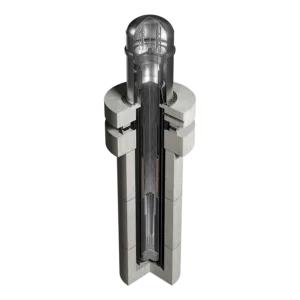
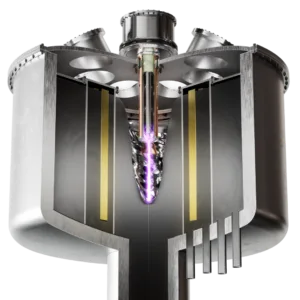
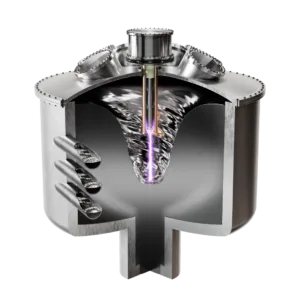
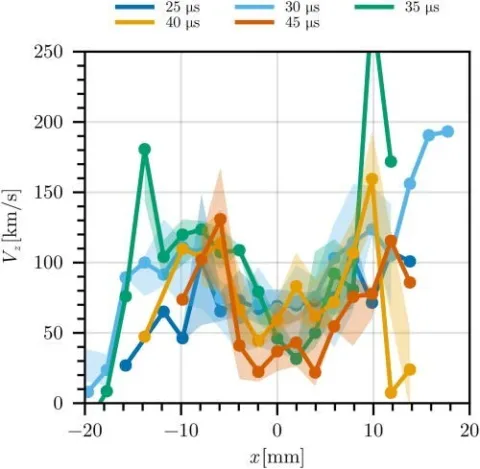
We report on the experimental characterization of long-lived, stable Z-pinch plasmas with sustained sheared flow in the FuZE-Q device. Running in a quasi-steady-state mode of operation, FuZE-Q produces approximately 50 repeat plasma pulses, which are diagnosed with fast-framing visible light cameras, collective Thomson scattering (TS), and ion Doppler spectroscopy. This work presents the first profile measurements of the majority ion species velocity in a flowing deuterium Z pinch using collective TS. The time dependence of the flow profile is reconstructed by scanning the acquisition time of the diagnostics. Axial flow velocities of deuterium range from 50 km/s on-axis to nearly 200 km/s at the pinch radius , giving flow differentials of approximately 100 km/s. Typical electron densities and temperatures in these low-pressure plasmas are and , respectively. These flow velocities are typically sustained for more than 15 μs, approximately 7.5 axial flow-through times. Interferometry measurements of the accelerator plasma show an approximately uniform electron density across the annular channel and a steady axial flow in these discharge conditions, implying that the Z pinch is steadily fueled by a stable upstream source. The stability of the Z-pinch plasma is investigated through the lens of visco-resistive and sheared-flow theory. Plasma parameters measured in this quasi-steady-state mode of operation place the Z pinches in the visco-resistive regime, with a characteristic Lundquist number . The shear flow is consistently super-Alfvénic, with a normalized shear , ranging from 1 to 3 that overlaps the lower end of and stabilization thresholds reported in kinetic and MHD simulations. This evidence suggests that sheared flow and visco-resistive dissipation jointly support stable operation against both modes.