
Effects of transitional orbit magnetization on transport and current in Z pinches
- Authors
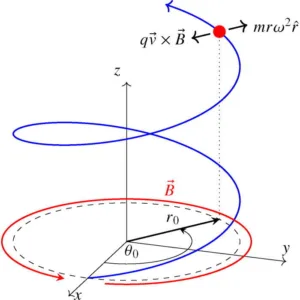
The azimuthal self-magnetic field of the ideal Z pinch contains a central magnetic null. Trajectories around this null govern transport in the core. Particles follow cyclotron orbits when the guiding-center approximation holds. Approaching the field null, where the ordinary guiding-center regime breaks down, particles exhibit trajectories called, in some historical contexts, betatron orbits. We quantify transitional magnetization between cyclotron and betatron orbits by a magnetization parameter that decomposes phase space into these orbit regimes. Considering the distribution of all orbits, this phase-space decomposition reveals a transitional magnetization region wherein both populations coexist. Classical magnetized transport theory fails within this region, where the diamagnetic drift reverses. The drift flux is instead supported by the flux of betatron orbits. Magnetic field dependent quantities which appear to diverge at the field null, such as cross field drift due to resistive electric fields, are physically resolved by the transitional magnetization of orbits. These transport modifications are governed solely by the number density per unit length in the ideal pinch.