Zap Energy's Integrated Approach to Fission and Fusion
- Authors
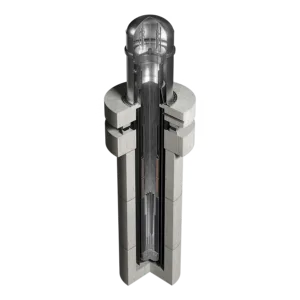
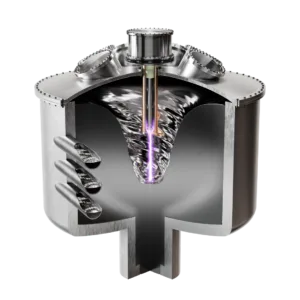
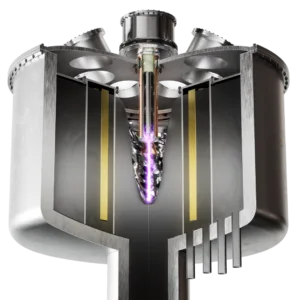
Demand for electricity is on the rise. The AI revolution in particular is triggering a surge in demand that is reshaping energy markets. Data center power usage is on track to grow more than 160% by 2030 compared to 2023 levels and Goldman Sachs forecasts that 85–90 gigawatts of new nuclear capacity would be needed to meet all the data center power demand growth expected by that year. Against this backdrop of renewed and urgent demand for advanced nuclear energy, Zap Energy is pursuing a single integrated platform strategy anchored in two fundamental reactions — deuterium-tritium (D-T) fusion and uranium-235 fission — each releasing millions of times more energy per reaction than any chemical process, enabling radically smaller fuel volumes and waste streams per unit of power produced. Rather than advancing these as independent efforts, Zap is deliberately designing a shared engineering, supply chain, and deployment architecture in which progress in one directly accelerates the other. Fission, already commercial and expanding into new microreactor form factors up to 50 MWe, offers a near-term market entry point leveraging Zap's demonstrated expertise in liquid metal cooling. Fusion, while not yet commercial, advances rapidly through Zap's sheared-flow-stabilized (SFS) Z-pinch approach at uniquely low cost. Alkali metals — specifically sodium and lithium — are central to both tracks. This alignment is intentional. Zap’s approach is to build common technical foundations—materials, liquid metal systems, high power density design, and neutron environments— once and apply them across both fission and fusion. As a result, engineering learning, vendor qualification, and operational experience compound across the platform rather than being duplicated. Sodium's high boiling point, exceptional thermal conductivity, and passive safety characteristics make it an excellent fission coolant, while lithium is irreplaceable in fusion as both coolant and tritium breeding medium. Critically, both product lines are being developed at similar physical scales (up to 50 MWe, ∼3–4 m core dimensions), maximizing engineering crosspollination and allowing hard-won manufacturing and operational lessons to compound in value across the portfolio. Looking further ahead, the high energy neutrons produced by D-T fusion open a path to fusion-fission hybridization, using Zap's fusion core to transmute minor actinides and address the growing inventory of spent nuclear fuel. The SFS Z-pinch geometry is particularly amenable to hybridization. The liquid-lithium blanket that already surrounds the fusion core for tritium breeding and heat extraction provides a natural medium in which to embed fission or transmutation targets, without requiring fundamental changes to the reactor architecture. Hybridization addresses this problem in ways that thermal reactors, fast reactors, and even accelerator-driven systems cannot fully match, positioning Zap at the frontier of both near-term clean power delivery and long-term nuclear fuel cycle closure.